Stitch Hole Spacing: Choosing a Pitch That Suits the Piece
7 July 2026 · 7 min read · Stitching & Hardware
SPI, millimetre pitch, corner planning and why an even hole count decides whether your seam ends cleanly.
Pitch is a design decision
The distance between stitch holes is the most visible piece of arithmetic in leatherwork. It sets the rhythm of the seam, and viewers read it instantly even if they cannot name what they are seeing. A fine pitch reads as refined and formal; a coarse pitch reads as rugged and traditional. Neither is better, but choosing without thinking produces pieces that feel subtly mismatched — a delicate card holder with saddlery-scale stitching looks like an accident, because it is one.
Pitch is quoted either in millimetres between holes or in stitches per inch. A 3 mm pitch gives roughly 8.5 SPI; a 4 mm pitch gives about 6.4 SPI. European irons are usually labelled in millimetres, Japanese irons often in both, and older British tools in SPI alone.
Matching pitch to thread and leather
Thread diameter and pitch must agree. A 0.45 mm thread in a 5 mm pitch looks sparse and mean; a 0.8 mm thread in a 2.7 mm pitch crowds the surface until the stitches touch and the leather between them tears under tension. As a rough guide, thread diameter should be somewhere near a sixth to an eighth of the pitch.
Leather thickness also constrains the choice. Punching a 2.5 mm pitch through 4 mm of firm veg tan removes so much material along the stitch line that the seam becomes a perforation — a tear-here line rather than a joint. Heavier leather wants more space between holes, both for strength and because the diamond chisel displaces more material as it passes deeper.
A practical pairing table: 1.0–1.5 mm leather with 2.7–3.0 mm pitch and 0.45 mm thread; 1.6–2.4 mm leather with 3.38–3.85 mm pitch and 0.55 mm thread; 2.5–4 mm leather with 4–5 mm pitch and 0.6–0.8 mm thread. Deviate deliberately, not accidentally.
Counting holes before you punch
The single most useful habit in stitch layout is calculating the hole count in advance. Divide the seam length by the pitch, then decide whether the remainder should be absorbed by shortening the seam slightly, by adjusting the pitch fractionally, or by placing the odd gap where it will be hidden.
A 148 mm seam at 3.85 mm pitch gives 38.4 spaces. Punching 38 spaces leaves 1.7 mm unaccounted for at the end — visible, and irritating. Punching 39 spaces requires a pitch of 3.79 mm, which no iron provides. The clean solution is to adjust the seam to 146.3 mm or 150.2 mm at the pattern stage, before any leather is cut.
This is why hole count belongs on the pattern, not in the moment. Once the panels are cut, your options shrink to compromises.
Corners, curves and symmetry
Corners are where careless layouts announce themselves. A stitch line that turns ninety degrees should place a hole exactly at the corner point, with equal spacing running away in both directions. Achieve this by punching outward from the corner rather than continuing blindly from one end.
Curves need the pitch measured along the arc, not the chord. On a tight radius, the outer edge of a folded gusset travels noticeably further than the inner edge; if you punch through both layers at once from the outside, the inner layer will bunch. Punch the outer layer, then use an awl to transfer the holes individually, easing the inner layer as you go.
Symmetrical pieces demand symmetrical layouts. On a wallet with two mirrored card slots, punch both from the centre outward so any leftover distance lands at the outer edges where it reads as intentional margin.
Tools and technique
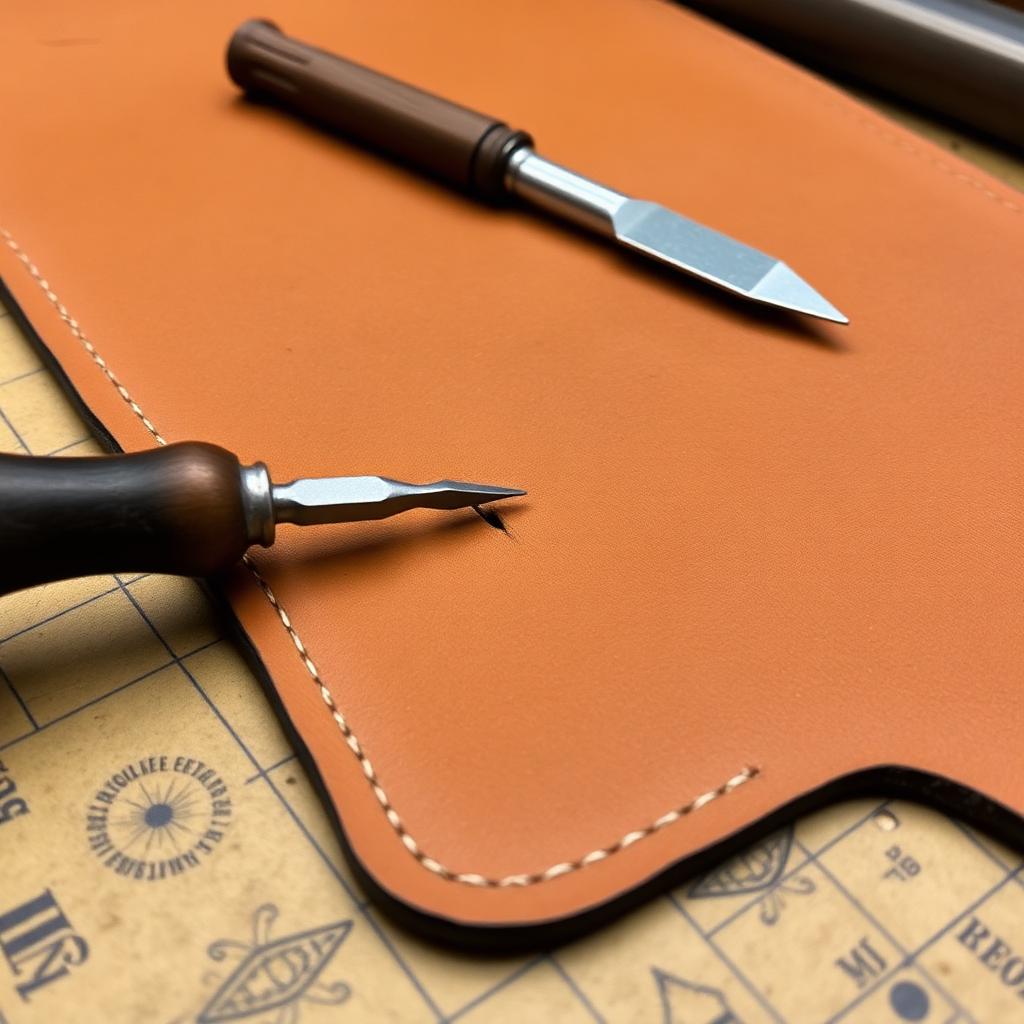
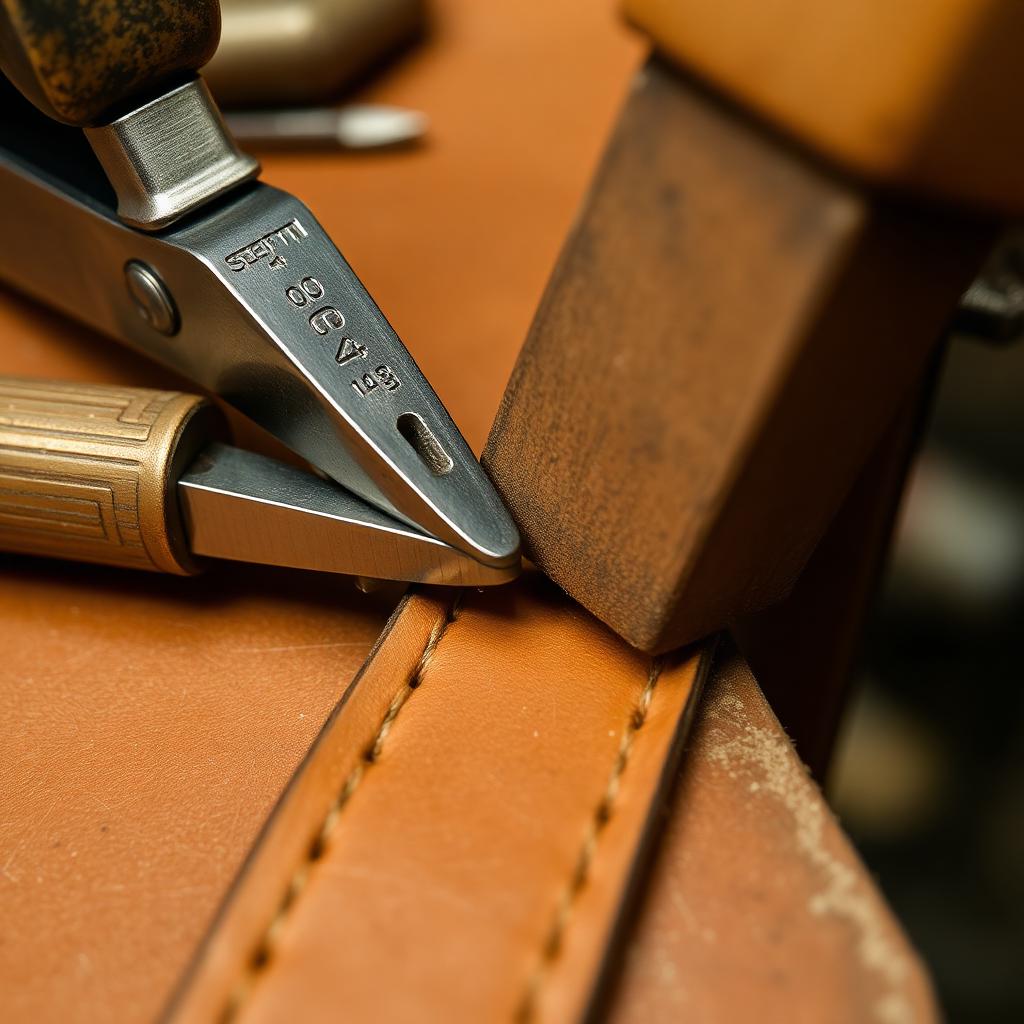
Diamond chisels cut a slot at an angle, which is what gives a saddle stitch its characteristic slant. Keep the angle consistent — rotating the iron between strikes produces a seam with alternating slants that no amount of good stitching can rescue.
Overlap the last tooth of the iron into the previous hole on every strike. This keeps spacing perfectly regular over long runs and is far more reliable than eyeballing the gap. On very long seams, mark the total run with a wing divider first so cumulative drift becomes visible early.
Punch into a poly cutting board, not into granite or wood. Poly protects the tips, which cost more to replace than the board, and it holds the leather steady enough that the slot stays clean on the flesh side.
Run the numbers with the hole spacing calculator before punching. It reports hole count, leftover distance and the adjusted pitch that would divide evenly — the three facts that turn stitch layout from a guess into a plan.