Choosing Thread: Linen, Polyester and the Numbers on the Spool
25 July 2026 · 9 min read · Stitching & Hardware
Thread size, fibre and wax all change how a seam looks and how long it lasts. A plain guide to reading spool numbers and matching thread to hole size.
Thread is a structural component
It is tempting to treat thread as a finishing detail chosen for colour, but in a hand-stitched leather good the thread is what holds the object together. A bag strap carrying five kilos transfers that load into a few dozen stitches, and each of those stitches is a loop of thread bearing tension across a leather edge. Choosing the wrong thread does not produce a slightly worse product; it produces one that fails at the seam while the leather is still perfect.
The two variables that matter most are fibre and diameter. Everything else — colour, wax type, twist direction — is secondary, though not irrelevant. Get fibre and diameter right and the seam will outlast the buyer's interest in the object.
Linen: the traditional choice
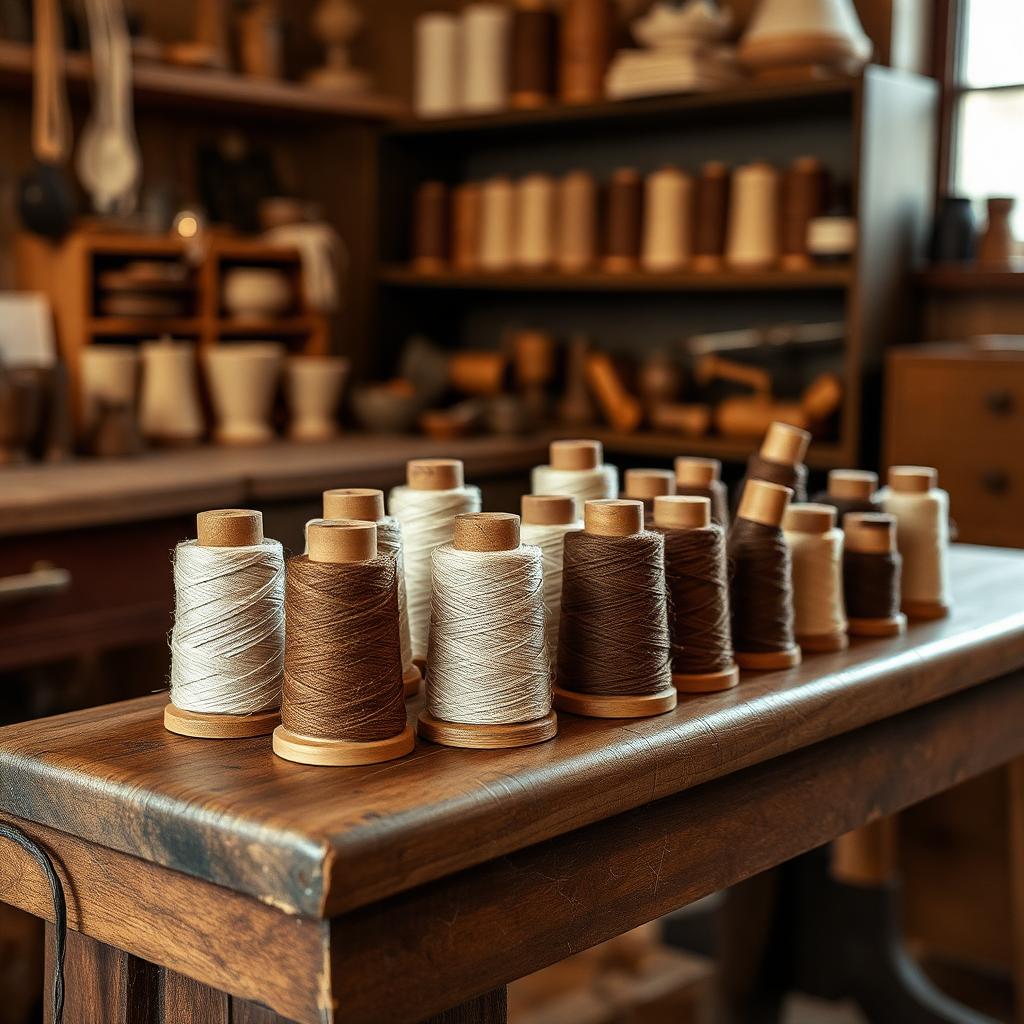
Waxed linen is what saddlers and bookbinders used for centuries and what many makers still prefer. It has low stretch, which means a linen seam stays tight rather than gradually loosening under repeated load. It grips itself, so a knot or a backstitch genuinely holds. And it ages sympathetically with vegetable tanned leather, dulling and softening at a similar rate rather than staying conspicuously new.
Linen is sold by a cord-and-ply notation such as 18/3 or 532: the first figure describes the fineness of the individual strands, the second the number of plies twisted together. In practice, 18/3 is a good general-purpose small-goods thread, 18/4 and 18/5 suit belts and straps, and heavier cords go into saddlery.
Its weaknesses are real. Linen is weaker than modern synthetics for the same diameter, it rots if stored damp, and it abrades where it crosses a hard edge. Hand waxing with a beeswax and rosin blend addresses most of this by sealing the fibre and adding grip, which is why almost nobody stitches with unwaxed linen.
Polyester: the modern default
Braided or twisted polyester — sold under names like Ritza 25 Tiger, Vinymo and Meisi — has become the default for contemporary small leather goods. It is substantially stronger than linen at the same diameter, entirely rot-proof, colourfast, and supplied pre-waxed with a coating that stays tacky enough to hold a stitch without gumming the needle.
Polyester is sized in millimetres of diameter: 0.45 mm, 0.6 mm, 0.8 mm, 1.0 mm and up. This is far more useful than the linen notation because it maps directly onto hole size. The working rule is that thread diameter should be roughly a quarter to a third of your stitch spacing: 0.45 mm thread for 2 mm spacing, 0.6 mm for 3 mm, 0.8 mm for 3.85 mm and above.
Thread that is too thick for the hole will not sit down into the slot, so the seam looks lumpy and the stitches stand proud where they will abrade. Thread that is too thin disappears into the hole and leaves a seam that reads as a row of dots rather than a line. Both errors are obvious in photographs even when they are subtle in the hand.
Wax, twist and colour
Wax does three jobs: it seals the fibre against moisture, it lubricates the thread so it passes through the hole without fraying, and it makes the finished stitch grip so a cut thread does not unravel. Pre-waxed polyester arrives ready to use. Linen usually needs hand waxing — draw the thread across a block of beeswax two or three times, then pull it briskly through a folded scrap of leather to melt the wax into the fibre.
Twist direction matters for one reason: a saddle stitch works best when the two needles pass in a consistent order and the thread does not untwist as you go. If your thread visibly frays and opens as you stitch, you are probably passing the second needle on the wrong side of the first.
Colour is design, but it is high-stakes design. A contrasting thread declares that the object is hand stitched and draws the eye to every irregularity. A matching thread hides small errors and reads as quieter and more formal. Beginners should probably match; the stitching line is the last place you want a spotlight while you are still learning.
How much to buy
Estimating thread is straightforward arithmetic that almost everyone gets wrong the first time. A saddle stitch consumes roughly three to four times the seam length in thread — the two-needle technique lays two passes plus the diagonal crossings plus the thickness of the leather at every hole — and then you need tails long enough to hold comfortably, typically 10 to 15 cm at each end.
For a 30 cm seam in 3 mm stacked leather at 3 mm spacing, that means about 100 to 120 cm of working thread plus 25 cm of tails. Cut generously: a thread that runs out three holes from the end costs you a visible splice, whereas an over-long thread costs a few pence and some extra pulling.
One spool of 0.6 mm polyester at 100 metres will stitch a surprising number of wallets. Buy two colours you will actually use — a natural and a dark brown or black — rather than a rainbow set that mostly sits in a drawer.
Tools mentioned in this article
- Stitching Thread Length Calculator — Work out how much waxed thread a saddle-stitched seam really needs.
- Stitch Hole Spacing Calculator — Balance stitch holes across an edge with even end margins.