Scaling Patterns Accurately Without Ruining the Proportions
26 May 2026 · 8 min read · Cutting & Pattern
Why enlarging a pattern by 20 per cent does not enlarge the capacity by 20 per cent, and which dimensions must never scale.
The temptation of the photocopier
You have a card holder pattern that works beautifully and a customer who wants something slightly larger for a passport. The obvious move is to scale everything up by twenty per cent. It is fast, it preserves the proportions you liked, and it produces a pattern that is subtly wrong in several ways at once.
Uniform scaling assumes every dimension in a pattern is proportional to size. In leatherwork, several critical dimensions are not — they are set by physics, by hardware, or by the human body, and they do not care how large the piece is.
What scales and what does not
Panel outlines scale. Overall height, width, flap depth, gusset length — these define proportion and should move together to preserve the design's character.
Leather thickness does not scale, and this is the most consequential exception. A larger bag made from the same weight leather is proportionally floppier because bending stiffness rises with thickness but load rises with volume. Scale up more than about fifteen per cent and you should usually move up a leather weight or add structure.
Seam allowances do not scale. A 4 mm allowance is 4 mm because that is what a stitch line needs to hold without tearing out. Scaling it to 4.8 mm just wastes leather and shifts your stitch line.
Hardware cutouts do not scale. A 20 mm strap slot stays 20 mm unless you are also buying wider hardware. Scaling a snap hole by twenty per cent produces a hole that no snap fits.
Card slots do not scale. A credit card is 85.6 by 54 mm everywhere on earth. Enlarging a card slot leaves cards loose and falling out — a failure that appears only after the piece is finished and loaded.
Fold and turn allowances scale only partially. The material needed to turn around a corner depends on thickness and radius, both of which behave differently from linear dimensions.
Area and material grow faster than you expect
Scaling a two-dimensional pattern by a linear factor multiplies its area by the square of that factor. Enlarge by twenty per cent and area rises by forty-four per cent. Enlarge by fifty per cent and area more than doubles.
This catches makers on the invoice as much as on the bench. A design that consumed 6 square feet at the original size consumes 8.6 at a twenty per cent enlargement, and the additional panels may no longer nest efficiently on the hide, pushing the real requirement higher still.
Volume grows faster again — with the cube of the linear factor for a three-dimensional bag. A twenty per cent larger bag holds about seventy-three per cent more, which is often more than the customer wanted and heavier than they expected when full. If a customer asks for 'a bit bigger', ask what they need to fit, and scale to that rather than to a percentage.
A method that works
Split your pattern's dimensions into three lists: scalable outlines, fixed functional dimensions, and semi-fixed allowances. Apply the scale factor only to the first list, keep the second untouched, and adjust the third by judgement.
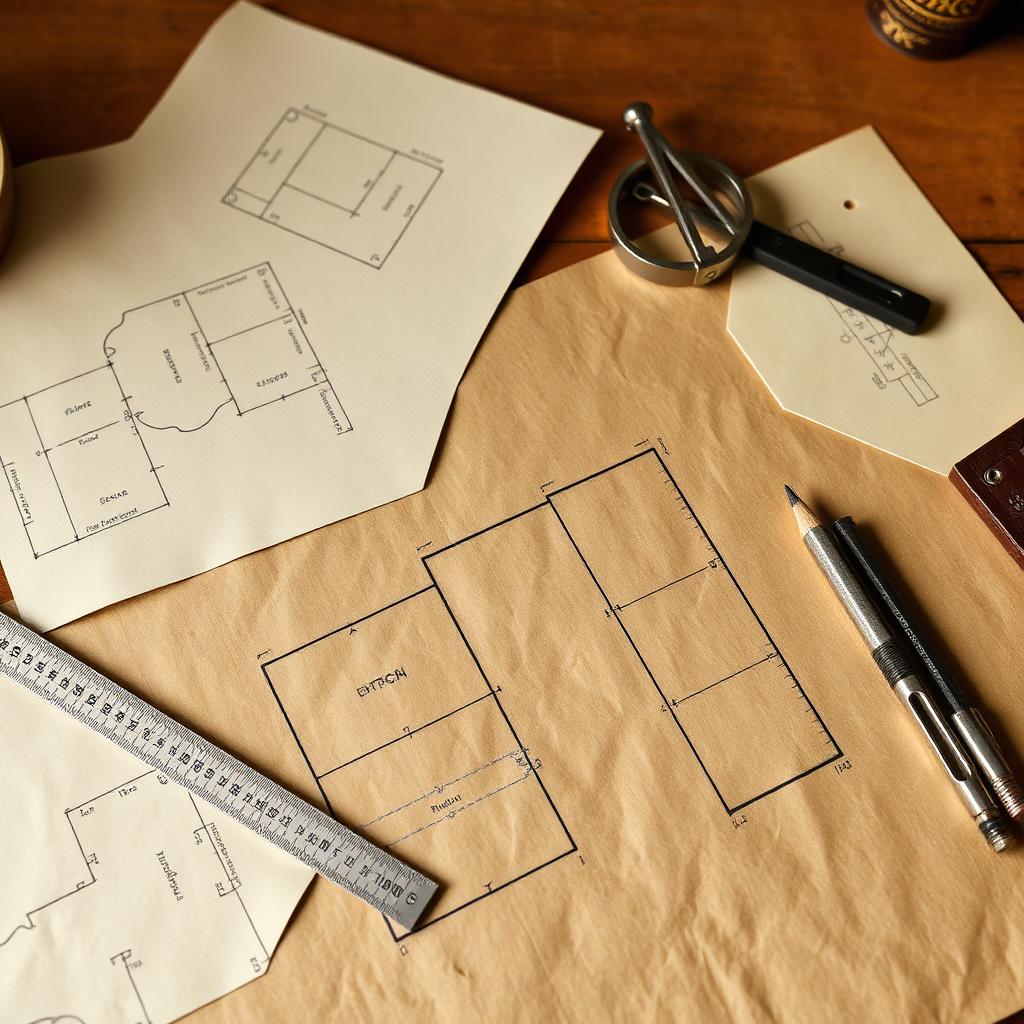
Redraw rather than photocopy. Working from a dimension list forces you to notice which numbers should not change, whereas a photocopier changes everything silently.
Build a mock-up in card or cheap fabric before cutting leather. Scaling errors are obvious in a five-minute paper prototype and invisible on a screen. Load the mock-up with the things it is meant to hold — cards, a phone, a notebook — and check that the proportions still feel right at the new size.
Check the stitch layout after scaling. A seam that divided evenly into holes at the original size will almost certainly not divide evenly at 118 per cent, and the leftover distance needs to be resolved on paper before it appears on leather.
Scaling down has its own traps
Reducing a pattern compresses everything toward the limits of the material. Corners that turned comfortably at full size become impossible radii; a 2 mm leather cannot form a 4 mm internal corner no matter how carefully it is skived.
Stitch pitch that looked balanced at full scale looks coarse on a miniature. Reduce the pitch as well — often to the next finer iron — and reduce the thread diameter to match.
As a general rule, scaling within plus or minus fifteen per cent is safe with minor adjustments. Beyond that, treat the result as a new design that borrows its proportions from the original, and prototype accordingly. The pattern scaling tool will handle the arithmetic and flag the fixed dimensions; the judgement remains yours.