How Much Thread Does a Saddle Stitch Really Need?
28 July 2026 · 7 min read · Stitching & Hardware
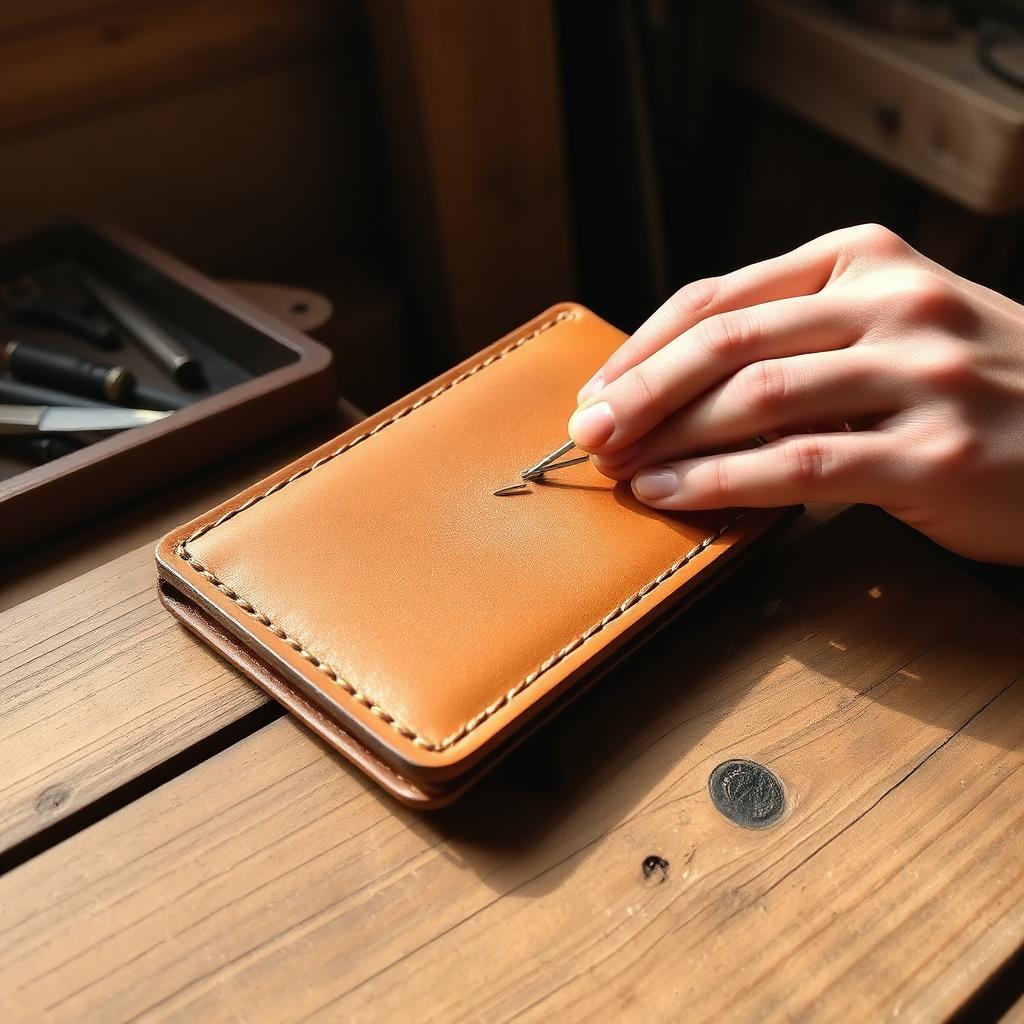
The arithmetic behind thread length, why the classic 'seam times three' rule fails on thick leather, and how to cut once without running short mid-seam.
The moment every maker dreads
There is a particular sinking feeling that only leatherworkers know. You are eight centimetres from the end of a long seam, the piece looks good, the stitches are even, and then one needle stops short. The thread has run out. There is no graceful recovery. You can splice, you can backstitch and start a fresh length, you can hide the join under a fold — but you will always know it is there, and on a piece you intended to sell, that knowledge is expensive.
The frustrating part is that thread is cheap and the calculation is simple. Running short is almost never a materials problem; it is an estimating problem. Most makers learn a rule of thumb early on, apply it to every project regardless of leather thickness or stitch density, and then quietly accept the occasional failure as bad luck. It is not bad luck. The rule of thumb is incomplete.
Why 'three times the seam' is only half a rule
The common advice is to cut thread three times the length of the seam. The logic seems sound: a saddle stitch passes two needles through every hole, so each stitch consumes thread on both faces of the work, roughly doubling consumption, and the extra length covers the tails you hold while working.
What the rule quietly ignores is the thickness of the leather. Every time a needle passes through a hole, the thread must travel the full depth of the material as well as the distance along the surface. On a 1.2 mm lining panel that vertical travel is negligible. On a 5 mm stacked belt with two layers of 2.5 mm shoulder, every single hole eats an extra centimetre of thread that the surface measurement never accounted for. Over a hundred and twenty holes, that is more than a metre of thread invisible to the classic rule.
Stitch density compounds the error in the same direction. A 2.7 mm pitch iron places roughly thirty-seven stitches per ten centimetres; a 4 mm iron places twenty-five. Switching to a finer iron for a refined look increases your hole count by nearly half, and thread consumption rises with it. Two makers stitching the same wallet with different irons need noticeably different lengths of thread, and no fixed multiplier can describe both.
A better model
A more honest estimate treats thread as the sum of three parts. The first is surface travel: the seam length, counted twice because a saddle stitch lays thread on both faces. The second is depth travel: the material thickness multiplied by the number of holes, doubled again because two needles cross at each hole. The third is a working allowance for the tails you grip, the backstitches at each end, and the small loss from the needle eye.
In practice that gives something like: total thread equals two times the seam length, plus roughly two and a half times thickness times hole count, plus a fixed allowance of thirty to forty centimetres. Applied to a 20 cm seam through 4 mm of leather at a 3.85 mm pitch — about fifty-two holes — the model asks for roughly 40 cm of surface travel, 52 cm of depth travel and a 35 cm allowance: a little over 1.2 metres, comfortably more than the 60 cm the naive rule would have suggested.
The numbers matter most on the projects where mistakes are costly. A knife sheath, a stacked belt, a bag gusset that curves through several hundred holes — these are exactly the pieces where the classic multiplier fails, and exactly the pieces where you least want a splice.
Practical adjustments at the bench
Waxed linen and polyester behave slightly differently. Heavily waxed linen grips itself and resists slipping through the eye, so you lose less to needle slip, but it also frays if you drag an excessive length through every hole. If your calculated thread exceeds about two and a half metres, consider stitching the seam in two deliberate sections with a planned, well-hidden join rather than fighting an unmanageable length.
Corners and folds consume more than flat runs. A gusset that turns ninety degrees pulls thread tighter around the bend and the effective thickness at the turn is greater than the flat measurement. Add five per cent for every sharp corner in the seam and you will rarely be surprised.
Finally, always round up to the next convenient length. Thread costs a fraction of a cent per centimetre. A ruined seam on a commissioned piece costs an evening, and sometimes a customer.
Building the habit
The best time to calculate thread is before the leather is even cut, while you still have the pattern dimensions written down. Measure each seam on the pattern, note the finished stack thickness at that seam, and record the iron pitch you intend to use. Three numbers per seam is all the calculation needs.
Once you have done this on five or six projects, the estimates start to feel intuitive. You will glance at a card holder and know it wants about ninety centimetres per seam; you will look at a briefcase gusset and reach for three metres without hesitating. That intuition is not magic — it is a mental model built from repeated, honest arithmetic, and it is the difference between a maker who occasionally runs short and one who never does.
Use the stitching length calculator on this site to run the numbers in a few seconds, then write the result directly on your pattern in pencil. The next time you make the same piece, the answer is already waiting for you.