Belt Length and Sizing: The Numbers Behind a Belt That Fits
16 June 2026 · 7 min read · Cutting & Pattern
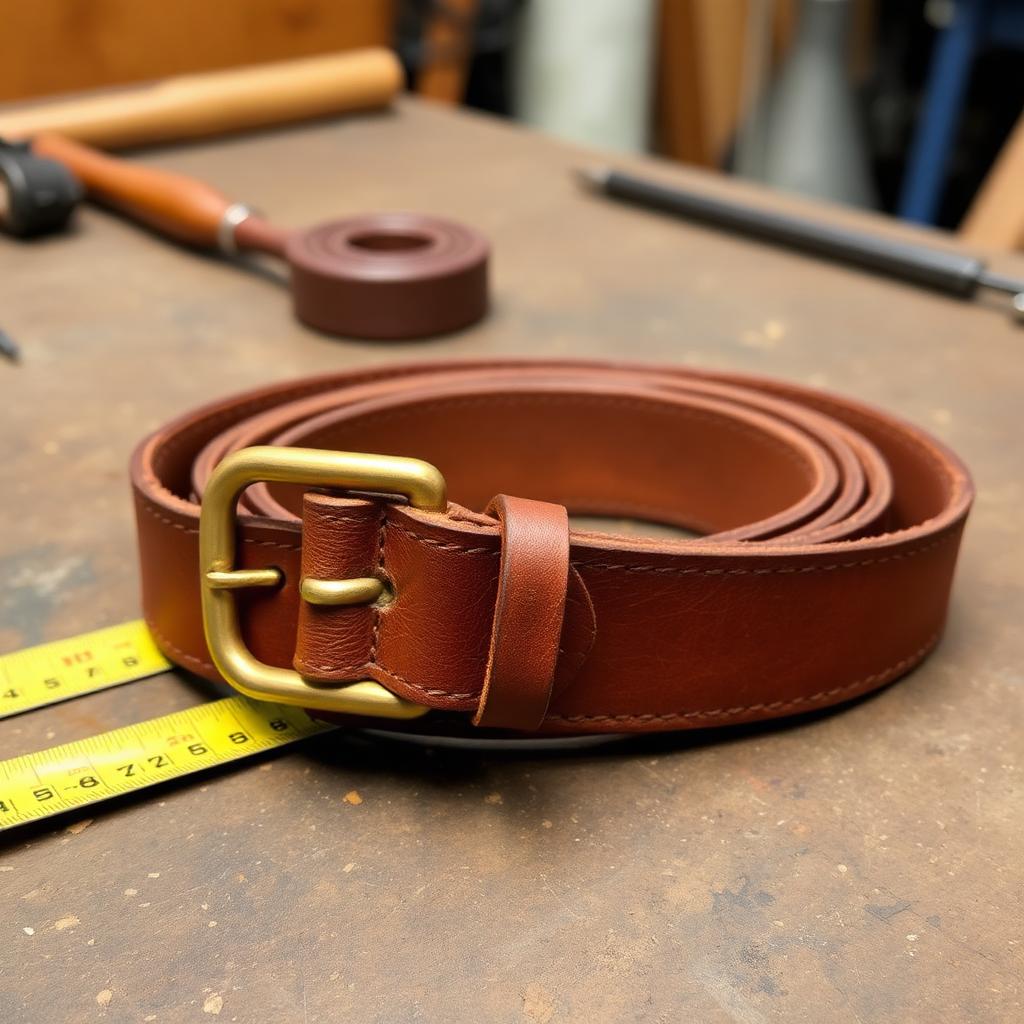
Waist size is not belt size. Buckle allowance, hole spacing, fold length and taper, explained for makers who take commissions.
The most returned handmade item
Belts are among the easiest leather goods to make and among the most frequently made wrong. The construction is simple: a strap, a buckle, a keeper, a few holes. The sizing is where it falls apart, because customers report the wrong measurement, makers apply the wrong allowance, and the finished belt buckles either at the first hole or the last.
A belt that fastens on its outermost hole looks like a mistake even if it fits. The intended appearance is the middle hole, with two holes of adjustment in each direction — enough for a heavy meal, a thick shirt, or a year of ordinary change.
Measure the right thing
Never use trouser size. A man who buys 34-inch trousers may have a 36-inch waist measured over the clothing he actually wears, and trouser sizing varies wildly between brands.
The reliable method is to measure an existing belt the customer likes: from the fold at the buckle end to the hole they currently use. That measurement is the belt's working length, and it is the number your pattern should reproduce.
If no belt is available, measure around the body at the exact position the belt will sit, over the usual clothing, with a tape held snug but not tight. That measurement becomes the centre hole position.
Building the total strap length
The strap you cut is longer than the working length by a predictable amount. Start with the working length. Add the buckle fold — typically 75 to 90 mm of leather folded back and stitched or riveted around the buckle bar, depending on buckle size. Add the tip allowance beyond the last hole, usually 60 to 80 mm so the tail sits properly in the keeper and the belt loop.
So a 90 cm working length with an 80 mm fold and a 70 mm tip needs a strap of roughly 105 cm before finishing. Cut a further 20 to 30 mm of insurance; trimming a long tip is trivial, extending a short one is impossible.
Thickness affects the fold. A 4.5 mm belt needs more length around the buckle bar than a 3 mm belt, because the leather cannot turn as tightly. Add five millimetres of fold allowance for every millimetre of thickness above 3 mm.
Hole layout
Standard practice is five holes at 25 mm spacing, with the centre hole at the working length. Some makers use 20 mm spacing for finer adjustment, and dress belts occasionally use seven holes.
Hole diameter should suit the buckle prong: 4 mm for light dress buckles, 5 mm for standard, 6 mm for heavy work buckles. Too large and the prong wanders; too small and the leather tears around the hole within a year.
Oval punches, oriented along the belt's length, distribute load better than round punches and are the traditional choice on high-quality belts. If using round holes, place the first hole no closer than 60 mm from the tip so there is enough material to resist tearing.
Taper, keepers and finishing
A tapered tip looks intentional and threads through loops more easily. On a 38 mm belt, taper the last 120 mm down to about 32 mm at the tip, or cut a rounded English point. Keep the taper symmetrical — an off-centre point is the first thing the eye finds.
The keeper should sit adjacent to the buckle fold and be sized for the belt's finished thickness plus the tail passing through it: internal length of roughly the belt width plus twice the thickness plus 2 mm of clearance. A tight keeper is a permanent irritation.
Finally, record every commission. Note the customer's working length, the buckle model and the finished strap length. Repeat orders then become a five-minute job rather than another round of measurement questions. The belt length calculator handles the arithmetic; your notebook handles the memory.